

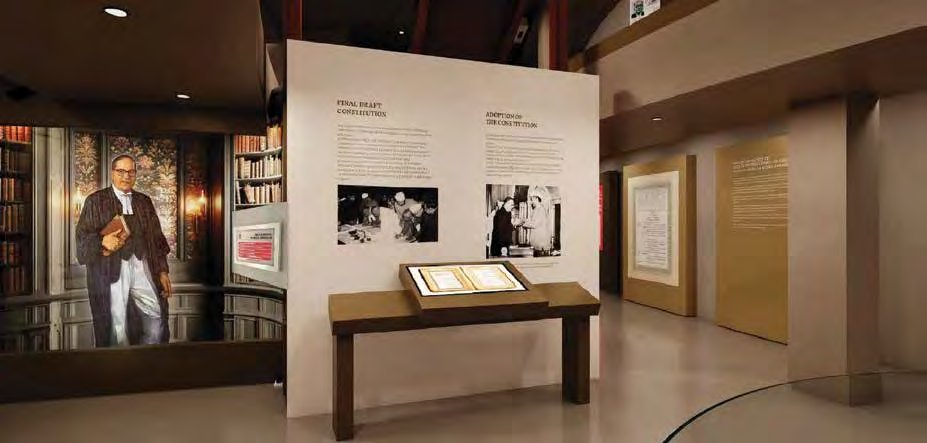
 The National Judicial Museum & Archive (NJMA) transforms the former Supreme Court Library into an immersive account of India’s judicial history and its continuing role in shaping the nation. Lemon Design conceived the museum as a living institution—one that preserves the past while remaining open to new judgments, ideas and milestones as the judiciary evolves.
Client: The National Judicial Museum & Archive (NJMA)
Works: Exhibit design, Scenography, Visual identity, etc.
Location: New Delhi
Design firm: Lemon Design
Complex legal histories and concepts were translated into an intuitive visitor journey through spatial storytelling, information design and interactive technology. Accessibility was embedded throughout, ensuring that the museum could be meaningfully experienced by visitors across languages, ages and abilities.
 Housed within the former Supreme Court Library, the museum was conceived not simply as an archive of landmark judgments, documents and artifacts, but as a living and evolving institution. Lemon Design developed the concept and visitor experience around this idea, creating a framework capable of presenting the history of India’s judiciary while continuing to grow alongside it.
The subject itself demanded clarity. Judicial history is extensive, layered and often difficult to navigate for visitors without a legal background. Lemon Design worked to distil this complexity into an accessible narrative, using spatial sequencing, graphics, media and interactive experiences to make legal ideas easier to understand without diminishing their significance.
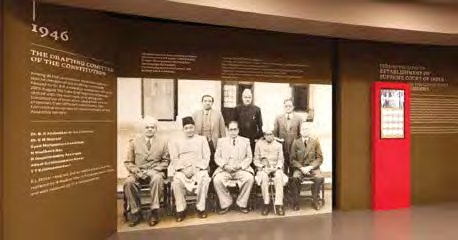 The architecture of the existing space became an important part of the experience. A compressed entrance opens into a larger volume with a mezzanine, creating a deliberate sense of discovery. Exhibits, artifacts and documents remain central, supported by a restrained and contemporary visual language designed to feel timeless rather than thematic.
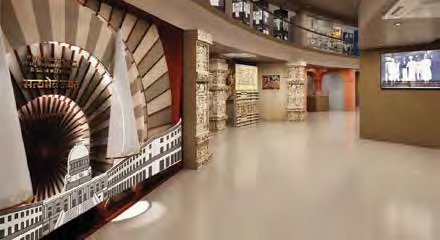 Technology was integrated where it could deepen understanding and participation. AI-enabled information interfaces allow visitors to explore judicial history on demand, while projection mapping, virtual reality experiences, interactive digital walls and a holographic representation of Dr. BR Ambedkar bring significant people, ideas and moments into the visitor journey.
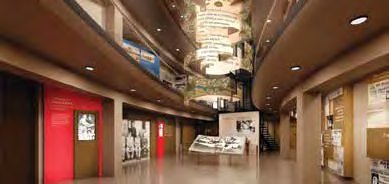 Accessibility was treated as a fundamental design requirement rather than an addition. Sign-language interpretation, braille panels, audio transcripts and wheelchair access were integrated across the museum, allowing a wider public to engage independently with the institution and its history.
Every layer—from identity, typography and signage to exhibit graphics and digital interfaces—was designed as part of one coherent system. Importantly, this system can accommodate new information and experiences over time, enabling the museum to remain current as India’s judiciary continues to evolve.
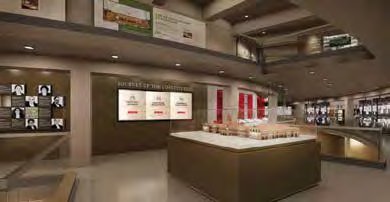 Inaugurated by former Chief Justice of India, DY Chandrachud, the NJMA transforms a complex institutional history into a public experience that can be explored, understood and continually rediscovered.
(Source/Courtesy: Lemon Design)
About Lemon Design
Lemon Design is a strategic branding and multi disciplinary design firm based in Pune with branch office at Noida in Delhi-NCR. For more than 25 years, the firm has been working with businesses, institutions and cultural organisations to define what they stand for, shape how they are experienced and design the systems that carry them forward.
So far, more than 900 design projects across diverse geographies, disciplines, industry & consumer archetypes as well as 150 plus branding systems for local, regional, startups, entrepreneurs, corporate, organisations, MNCs, etc. have been completed by Lemon Design.
(For more details, visit: https://lemondesign.co.in)


